
It is often said that 70% of a product's cost is decided in design. The sentence is useful and, read without nuance, also misleading. This document explains what it means, what supports it, where it stops being valid and what it implies for the moment a team decides what to build.
8 min read
A much-repeated sentence
A rule circulates in cost engineering: most of a product's cost is determined before the first unit is built. The figure is usually placed between 70% and 85%, and it appears in design-for-manufacturing handbooks, in cost-estimation software and in management presentations.
The rule is valuable because it moves attention to where the leverage is. It becomes misleading when it is read as a law measured with precision. To use it well, three questions need to be kept apart: what it says, what supports it and where it stops being valid.
Committed cost and spent cost
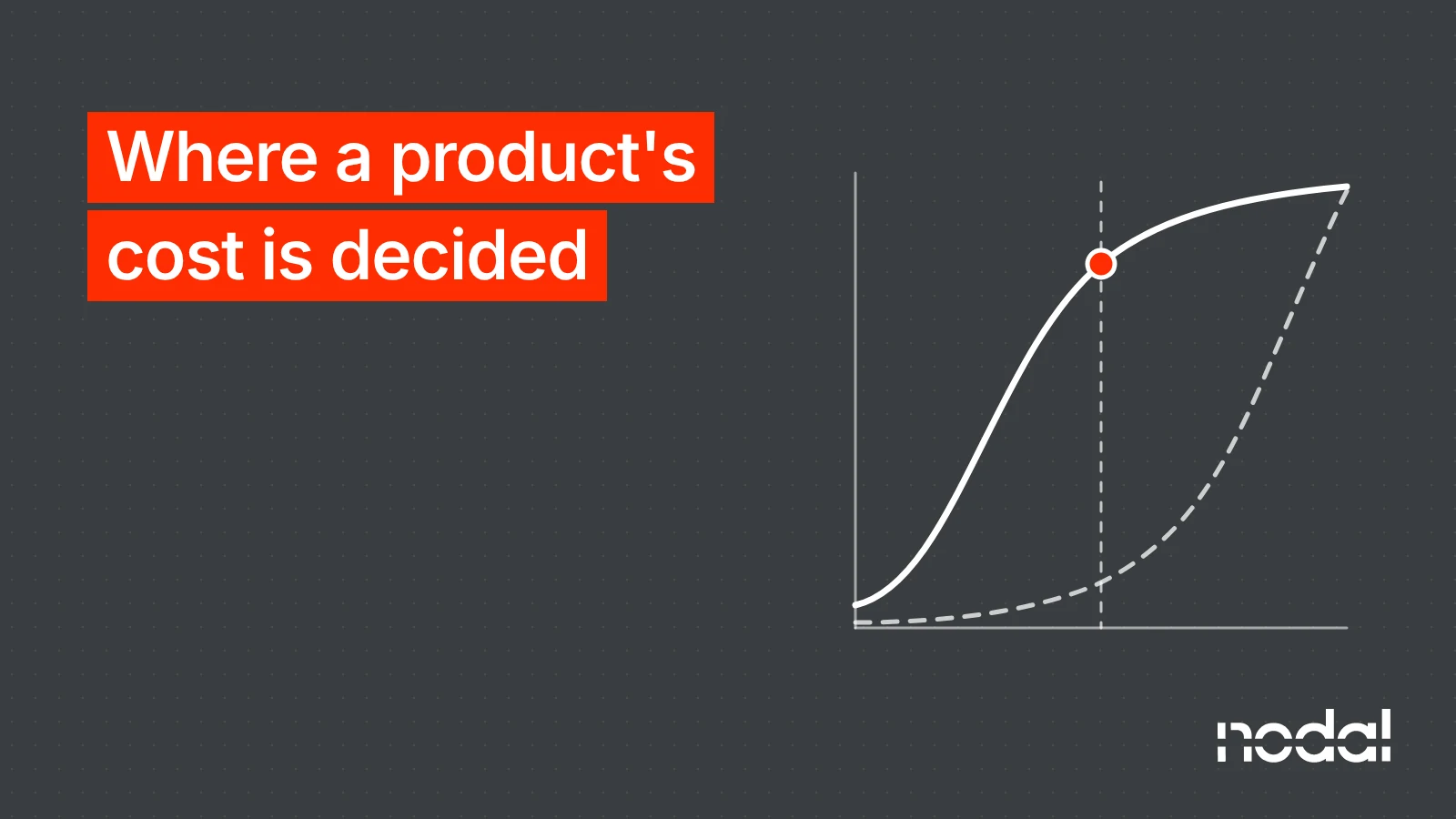
The sentence mixes two quantities that follow different paths. Spent cost is the money the company actually pays out: low during design, rising through industrialization and highest in production. Committed cost is the cost fixed by decisions already made, even if it has not been paid yet.
- Committed cost
- Spent cost
- 01Concept validation before development
- 02Design
- 03Industrialization
- 04Production
- 01Concept validation before development
- 02Design
- 03Industrialization
- 04Production
What sustains the rule is not how much design costs, but how much room is left afterwards. Once the design is closed, the factory can optimize within the limits already set, not outside them.
Which decisions fix the cost
Six design decisions explain much of what is later paid in manufacturing. The design for manufacture and assembly (DFMA) literature deals with exactly these, above all with part count and ease of assembly (Boothroyd, Dewhurst and Knight, 2010).
Part count and geometry
Every part adds tooling, inspection, assembly and a possible point of failure. Reducing parts is one of the classic routes to cost reduction in DFMA.
Materials
The material determines, at once, the price per kilo, the possible processes, the supplier and how the product behaves at end of life.
Manufacturing process
Moulding, machining, casting or stamping a part involves very different investments, cycle rates and unit costs, and the choice is made when designing.
Tolerances
Demanding more precision than the function requires raises manufacturing and quality-control cost on every unit.
Assembly
A design that is hard to assemble pays that cost on every unit produced, for the whole life of the product.
Technology and supplier
Choosing a technology or a supplier creates investments and dependencies that are costly to change later.
What supports the figure
The figure does not come from a single measurement. It is attributed to studies at large manufacturers whose original documentation is hard to trace, and it has been repeated for decades with variations (70%, 80%, 85%). Three studies allow it to be placed more rigorously.
| Study | Context | What it finds |
|---|---|---|
| Ulrich and Pearson (1993) | 18 drip coffee maker models from several manufacturers, assessed across six manufacturing scenarios. | The cost variation attributable to design was about 48% of average manufacturing cost, and the variation attributable to the production system was about 31%. Both levers weigh comparably, far from the 80% usually attributed to design. |
| Barton, Love and Taylor (2001) | Critical review of the claim that design determines 70% of cost. | Questions whether the figure has been demonstrated. Argues that design should be evaluated together with downstream activities and with the company's real operating environment, not an idealized scenario. |
| Tan, Otto and Wood (2017) | Unmanned aerial vehicle development, with requirements tracked phase by phase. | In that programme, 86% of total expected cost was determined before design freeze and 34% before concept freeze. The authors present this as quantitative support for the 80-20 rule in mid-sized aerospace-level systems. |
Read together, the three studies say something more useful than the figure. Design has a large and early influence on cost, but its exact weight depends on the product, the sector and how cost is measured.
The cost of changing late
Committed cost has a practical consequence: a wrong decision costs more the later it is detected. Two studies illustrate it from different angles.
In the work of Tan, Otto and Wood, defects originating in the concept phase required on average 13 times more correction activities when detected late than when detected immediately. It is a measure of engineering activities, not of euros, and it comes from a single sector.
Terwiesch and Loch (1999) analysed how engineering changes are handled in the development of an automotive climate control system. The administrative process of a single change could take weeks, months and, in extreme cases, over a year, because of approvals, cascading effects on other components and resource constraints.
Neither study supports a universal multiplier. They agree on the direction: changing late is slower and more expensive than deciding well at the start.
- 01Concept validation before developmentDecided here
What product to build and whether it is worth it
Room to changeVery highCost of changingLowNodal's stage - 02DesignDecided here
Architecture, materials, processes and part count
Room to changeHighCost of changingMedium - 03IndustrializationDecided here
Tooling, suppliers and production line
Room to changeMediumCost of changingHigh - 04ProductionDecided here
Volume, quality and logistics
Room to changeLowCost of changingVery high
What this means for a product team
If the leverage is in the early stages, cost should be treated as a design variable from the start and not as a later calculation. This is the idea behind design-to-cost: set a target cost before designing and use it as a constraint.
The earliest stage comes before CAD. It is the moment when what to build is decided. There, changing direction does not mean redoing geometry, tooling or contracts. What it does require is information: market, user, technical feasibility, cost and risk, assessed against the company's real context.
How Nodal takes part
Nodal works in that first stage. It brings together the brief, the company context and market and sector evidence to make visible the conditions, risks and open assumptions of a product direction before development begins. It does not replace detailed engineering or cost calculation with real quotes. Its role is to improve the starting decision, with the origin of each data point traceable.
Frequently asked questions
What does it mean that 70% of cost is decided in design?
That most of the cost is committed by design decisions (parts, materials, process, tolerances, suppliers), even though the money is spent later, in manufacturing. It is not what designing costs, but what gets fixed while designing.
Is it an exact figure?
No. It is a heuristic. A study of coffee makers found that design and the manufacturing system weighed comparably, and another on unmanned aerial vehicles placed the cost determined before design freeze at 86%. The percentage depends on the product, the sector and the definition of cost.
Why is changing late more expensive?
Because a late change means redoing work already done and moving decisions that other decisions treat as fixed: geometry, validations, tooling, suppliers. The more advanced the product, the more dependencies each change drags along.
How is cost reduced from design?
By treating cost as a constraint from the start, applying design for manufacture and assembly criteria and, before all of that, deciding the concept well, which is when the room for change is greatest.
References
- Barton, J. A., Love, D. M. & Taylor, G. D. (2001). Design determines 70% of cost? A review of implications for design evaluation. Journal of Engineering Design, 12(1), 47-58. doi.org/10.1080/09544820010031553
- Ulrich, K. T. & Pearson, S. A. (1993). Does product design really determine 80% of manufacturing cost? MIT Sloan School of Management, Working Paper 3601-93. dspace.mit.edu/handle/1721.1/47202
- Tan, J. J. Y., Otto, K. N. & Wood, K. L. (2017). Relative impact of early versus late design decisions in systems development. Design Science, 3, e12.
- Terwiesch, C. & Loch, C. H. (1999). Managing the Process of Engineering Change Orders: The Case of the Climate Control System in Automobile Development. Journal of Product Innovation Management, 16(2). repository.upenn.edu/handle/20.500.14332/42219
- Boothroyd, G., Dewhurst, P. & Knight, W. A. (2010). Product Design for Manufacture and Assembly (3rd ed.). CRC Press.